Showing posts with label Contagion. Show all posts

Tuesday, 18 March 2014

The next bubble - Chinese Property & Construction Debt ?


If you haven't heard of it, try to get your hands on Project X. It is a movie about teenagers plotting to throw a house party while the parents are away. And what they actually pull off is beyond huge ... it is a party of epic proportions. The kind you wish you had, that turns you into an instant local hero in the eyes of your fellow party monsters for years to come. 


But so too is the fall out and hangovers afterwards - epic. Warning - if you have kids, you might decide to preemptively lock them up for good after seeing this. 

It seems like the party might soon be over for Chinese property developers too.   Available information seems to point out that until recently Chinese construction was like a Project X type house-party of epic proportions. Everybody has had a ball of a time, building ghosts cities and constructing new developments all over the place like there is no tomorrow. 


Source: http://www.ibtimes.co.uk/china-ghost-town-city-441932

Read more about it:
 How to spot a bubble - step 16

But as with all good things in life, it seems like that part of the house party where everybody were having a blast, might be over. The party music is not pumping that loud anymore, the bottomless beer is starting to run out, the pretty people don't look that pretty anymore, and head aches are setting in. 

The first cracks in the wall started appearing. In the last 2 or so weeks the first debt defaults on Corporate Bonds started happening - sit tight and read the Bloomberg article here

It is interesting to note that during the previous (East) Asian collapse (which coincidentally also had an exceedingly optimistic construction growth spurt in places like Thailand), the first rumbles of collapse also started with default on bonds issued by construction companies - read more about that here

Read these two articles by Zerohedge for further information:
Obviously one cannot keep on kicking the can down the road and borrow money like there is no tomorrow. At some stage somebody has to pay the Pied Piper. 

And undoubtedly, other people would have made brave decisions on where to invest your money.  At this stage it is anybody's guess how much (international?) investment might be tied up in these bonds - and what exactly will be extent of contagion this time? How will it impact the economy? What about global markets?

But what is clear, is that barring a small miracle, the epic house-party just might be over.


Google+

Wednesday, 19 February 2014

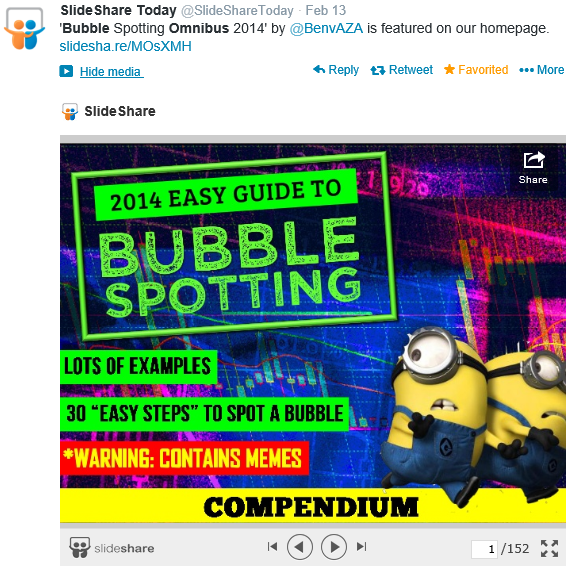
How to identify a bubble - as featured on Slideshare

How to spot a bubble 


My 2014 Bubble Spotting Omnibus has been featured on Slideshare !

 Bubblespotting Omnibus - to view click here

Will this be you during the next market crash ?  Wait, what market crash, when ? Where?


Judging by current market conditions, we might be in for an interesting ride....

 If you have been following my blog, you may have noticed that I have been doing a bit of reading up on market bubbles  - how do they form, which conditions are present, what happens in the process of building up, and what happens after the bubble bursts.

In the process of doing this research I discovered some fascinating information on the topic. I decided to put all the info in presentation format - this is so anybody who may be interested in this topic, can have a look


The Bubblespotting 2014 Omnibus presentation starts with one of the earlier recorded (and completely man-made bubbles) which was the Tulip Bubble in the Netherlands. It furthermore then covers (in a easy readable and quick summary format) a number of major economic bubbles in different markets around the world which have taken place since. These examples cover a diverse range of bubbles up to and including the Subprime crisis, which was the most recent very big bubble that popped. 

Also incorporated are some present-day pop culture examples, which, even though not strictly classifiable as a typical financial bubble (by a long shot), still interestingly enough display some of the same attributes.


The presentation furthermore covers some of the key characteristics and highlights commonalities between these various investment bubbles (apart from some of the more spectacular market meltdowns) - in the process identifying a number of conditions / characteristics which appear to be present in the build-up and blow down phases. 

In order to keep the theory interesting, it is explained with the use of memes and a bit of humour. 


Read it and see if you can recognize anything familiar happening in your neck of the woods?


Hope you like it - comments welcome.

Google+

Saturday, 15 February 2014

The Subprime crisis - another contagion case study

Below is a short presentation that summarizes key aspects of the Subprime crisis - factors causing and contributing to the bubble, and what happened in the aftermath of this #bubble.


The Subprime crisis (for at least the second time in recent history - the other being the Asia debt and currency crisis in 1997), showed the massively devastating effect that contagion can have on the financial markets on a global basis.  Whilst the crisis (at least on the surface) appeared to have its original in one market (being a specific portion of the residential housing market), it quickly proved that it was not an isolated problem, as the problem spread into various other local and international investment markets.  

Due to the increasing complexity of financial instruments these days, as well as the interwoven nature of markets and international cross-border transactions, going forward it is safe to say that it will become more and more difficult to isolate a sick patient (market experiencing a bubble) in time to prevent loss of money. 

Furthermore the current electronic age is aiding and abetting in both the ease as well as speed of transmission (infection).  The fall and or crash of a specific market on one side of the world will within minutes or seconds cause a ripple effect and spread to other markets. And one cannot stop this by quickly unplugging the computer after hearing the lightning strike or seeing the flash.

The risk of contagion will therefore in all likelihood pose very unique challenges in the financial world going forward.  One could argue that, as a minimum, the nature and extent of due diligence required prior to making any kind of future investment decision, would require some serious consideration. But not only this -  political as well as financial policy formulation can perhaps do with some rethinking as well. There seems to be not enough consideration or understanding of the potential cause and effect of proposed strategies or policies these days. And general ignorance about Newton's Laws. The words "unintended consequences" and "collateral damage" have become meaningless and empty rhetoric, used by those who have little intention of taking any responsibility for their decisions. 


Google+

Friday, 31 January 2014

Interesting times ahead ...


This story that broke on Bloomberg yesterday is what I had hoped not to hear for at least another couple of months. The word "contagion" is generally not used lightly - read the story here:
http://www.bloomberg.com/news/2014-01-30/calm-broken-in-global-markets-amid-concern-of-emerging-contagion.html

 Contagion

Today everywhere is down except for American Markets - Source Bloomberg SAST 12:00  on
31 Jan 2014

 Click to see current status


And then the news that Emerging Markets lost $ 10 billion in the past week - which would explain why so many emerging currencies around the world tanked so dramatically in the last week or 2.  Also see which Emerging Economies are appearing most at risk ... now add to that the current situation in these countries:
 BBC NEWS - Click to read article
Ukraine - Photo courtesy of BBC News

Seems like we might be in for a bit of a bumpy ride ? 


Google+

Monday, 13 January 2014

The East Asian Currency and Debt Bubble


The next Bubble was the first to catch my attention growing up. This happened when I started out with my professional career

I can specifically remember a tv news report that the East Asian economies were growing at an enormous rate... So much so that students opened credit card accounts and used that to speculate with shares on the stock exchange. Due to rapid growth they could flip the shares before they had to pay the debt. I was tremendously impressed.

The the bubble burst and hit us over the couple of months.

This bubble is an excellent example of the massive damage that can be done with reckless speculation in the financial markets (specifically forex trading), and also illustrates the devastating impact of the power and damage that can happen once contagion occurred


Follow me on Google+